The first time I switched from low risk to high risk in a Plinko game, I genuinely gasped. Not because I won big — I didn't. The ball landed dead center and I got basically nothing. But the multiplier labels at the edges of the board had jumped from modest numbers to triple digits, and suddenly every drop felt like it mattered in a completely different way.
That's the thing about Plinko risk levels that nobody tells you upfront: the ball physics don't change at all. The pegs are in the same spots. Gravity works the same way. What changes is the meaning of where the ball lands. And that single variable transforms the entire experience.
If you're new to Plinko and wondering what the game is all about, I'd start there. But if you already know the basics and you're trying to figure out whether to play it safe or swing for the fences, you're in the right place. Let's break down all three risk levels so you can stop guessing and start playing the mode that actually suits you.
Understanding Plinko Risk Levels
Before we get into the specifics, let's clear up what "risk" actually means in the context of Plinko. It's not about the ball doing anything differently. It's entirely about the numbers printed on the slots at the bottom of the board.
On a low risk board, the multipliers are relatively flat. The center slots — where the ball lands most often thanks to the bell curve — might pay 1.2x or 1.5x, and the edge slots might go up to 5x or 8x. The range is narrow. On a high risk board, those center slots might drop to 0.2x or even 0x, while the edges skyrocket to 50x, 100x, or higher.
Same board. Same physics. Completely different emotional experience.
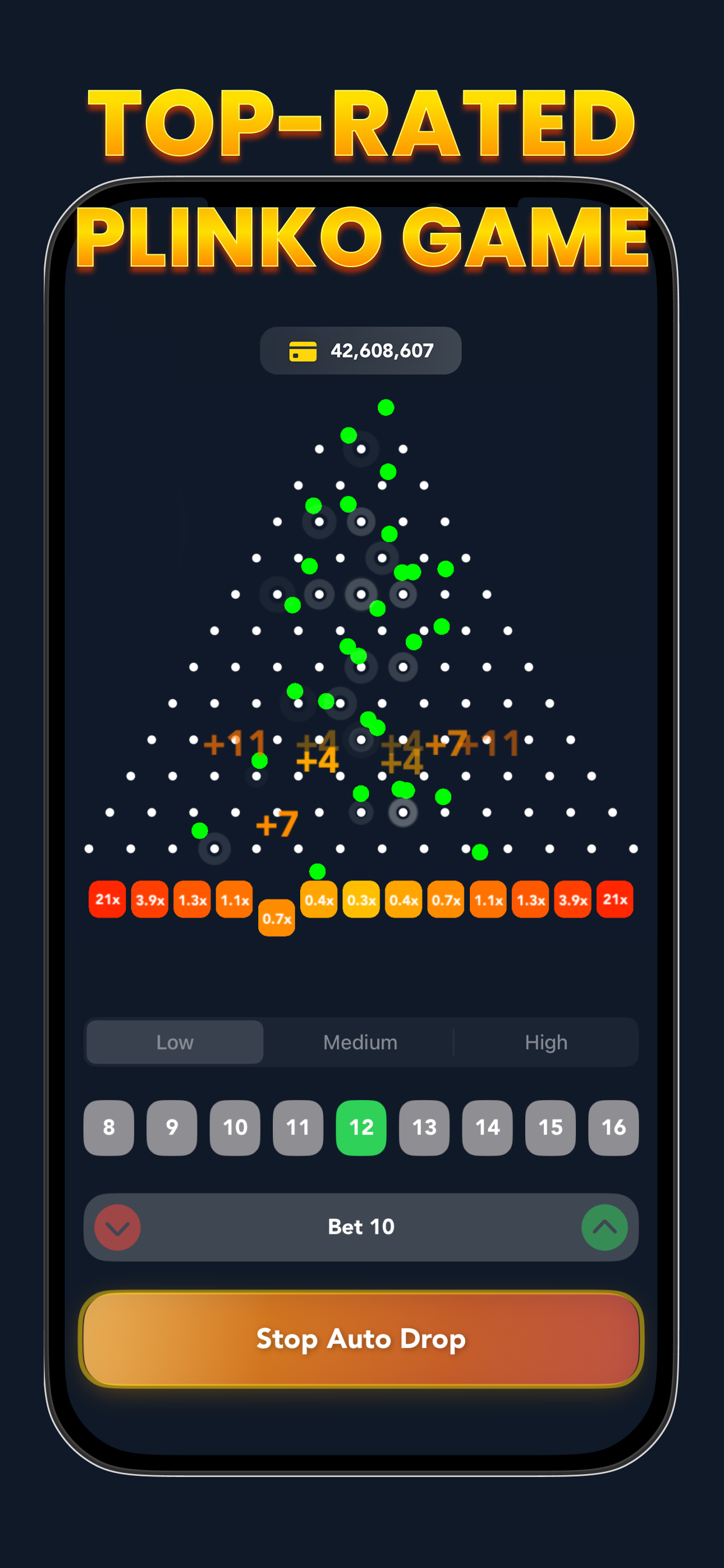
Think of it like this: the risk setting is a lens that you're placing over the same Plinko board. Low risk is a wide-angle lens — everything looks smooth, even, predictable. High risk is a fisheye — the edges are dramatically amplified while the center gets compressed almost to nothing. The underlying reality (where the ball lands) hasn't changed. Only how you feel about the result.
Understanding this distinction is important because it means risk settings don't affect your long-term odds in a mathematical sense — they affect the distribution of your results. Low risk gives you lots of small wins. High risk gives you lots of small losses punctuated by occasional massive wins. Over enough drops, they even out. But "enough drops" might be thousands, and the ride getting there is wildly different.
Low Risk Mode Explained: Steady Small Wins
Low risk Plinko is what I'd call the "zen garden" of risk settings. It's calm. It's predictable. And it's surprisingly satisfying once you stop chasing adrenaline and just let the game breathe.
Here's what happens mechanically: the multiplier values across all the bottom slots are compressed toward the middle. The center slots — where the bell curve sends most of your balls — pay at or slightly above your base amount. The edge slots still pay more, but not dramatically more. The floor is higher, and the ceiling is lower.
What Low Risk Feels Like
Imagine dropping 20 balls in a row. On low risk, maybe 14 of those drops return between 1.0x and 1.5x. Another 4 might land on 0.5x or 0.8x — small losses, barely noticeable. And 2 might hit 3x to 5x for a nice bump. Your balance after 20 drops is probably within 10-15% of where you started, maybe slightly up, maybe slightly down.
There's no moment where you lose your shirt. There's also no moment where your jaw hits the floor. It's steady. And for a certain type of player, that steadiness is the whole point.
Who Should Play Low Risk
- New players learning how to play Plinko for the first time
- Relaxation seekers who play Plinko to unwind, not to gamble
- Long-session players who want to stretch their balance across hundreds of drops
- Physics enthusiasts who are more interested in watching the ball's path than the multiplier it lands on
A low risk strategy works best when you're not emotionally attached to any single drop. You're watching the cumulative trend, not individual results. It's Plinko as a meditative experience rather than a rollercoaster.
Medium Risk — The Balanced Middle Ground
If low risk is the zen garden and high risk is the rollercoaster, then medium risk is a spirited hike through interesting terrain. There are some flat stretches and some steep bits, but nothing that's going to give you vertigo or put you to sleep.
Medium risk opens up the multiplier range without going to extremes. The center slots still pay decently — maybe 0.5x to 1.0x — while the outer slots climb to 10x, 15x, or even 25x depending on how many rows you're playing with. You'll see more variation in your results, but you won't go broke from a bad streak of center landings the way you can on high risk.
Why Medium Risk Is the Most Popular
Medium risk is the most-played setting across almost every Plinko game, and I think I know why: it satisfies both sides of your brain. The cautious side sees that most drops return something reasonable. The thrill-seeking side sees those double-digit multipliers on the edges and thinks, "Maybe this next one..."
The volatility on medium is what I'd call "interesting but manageable." Your balance goes up and down, but it doesn't do anything violent. You might have a streak of ten drops where nothing exciting happens, and then ball number eleven clips a peg at just the right angle, bounces to the outer zone, and pays 18x. That single drop makes the entire session feel worth it, and it happens often enough on medium risk that you're never waiting too long.
The Strategic Sweet Spot
If you're the type of player who reads Plinko strategy guides and actually thinks about your approach, medium risk gives you the most to work with. The multiplier distribution is nuanced enough that your drop position at the top of the board starts to matter more. Edge drops versus center drops produce meaningfully different outcome distributions, which gives you at least the illusion of control — and in a game of pure chance, the illusion of control is everything.
High Risk Mode — Big Multipliers, Rare Wins
Okay. Let's talk about the beast.
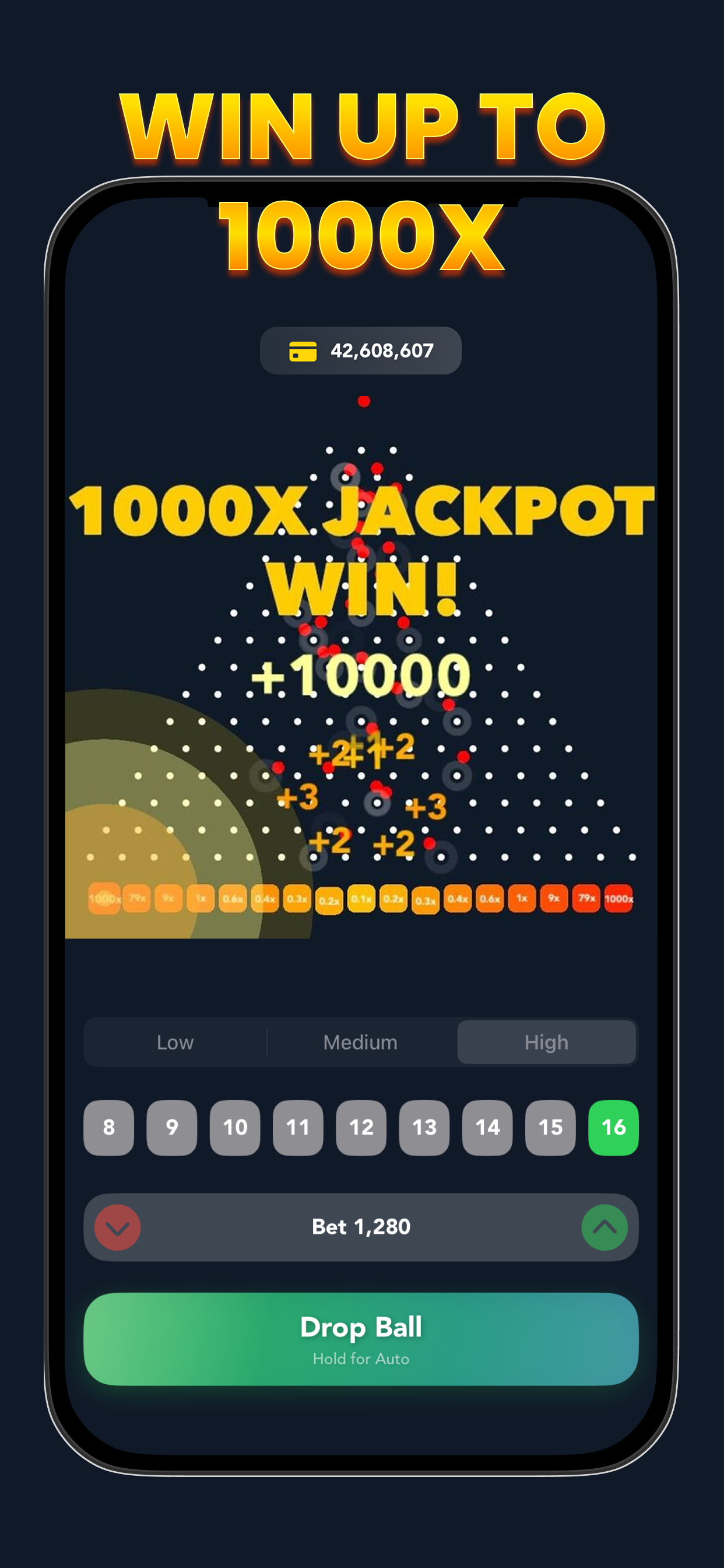
Plinko high risk is where the multiplier labels at the bottom of the board look like they belong to a completely different game. The center slots — the ones where 60-70% of your balls are going to land — are labeled 0x, 0.2x, 0.3x. Basically nothing. Maybe less than nothing. Meanwhile, the outermost edge slots are labeled 100x, 200x, or more.
This is plinko as a spectator sport. Every drop is either devastating or transcendent, with very little in between.
The Mathematics of High Risk
Here's what makes high risk strategy so psychologically tricky. The bell curve hasn't changed — the ball still lands near the center most of the time. But on high risk, landing near the center means you lose most of what you put in. You need those rare edge landings to compensate for all the center drops, and the math says those edge landings will come eventually. The problem is "eventually" might mean 50 drops. Or 200. Or 500.
This is extreme volatility in action. Your balance chart on high risk looks like a heartbeat monitor during a horror movie — long stretches of decline punctuated by sudden, violent spikes upward. If one of those spikes happens early in your session, you feel like a genius. If it doesn't, you watch your balance erode drop by drop and wonder why you didn't just play medium.
Who Actually Thrives on High Risk
- Thrill seekers who play specifically for the adrenaline rush
- Short-session players who want to drop a few balls, see if anything crazy happens, and move on
- Experienced players who understand variance and have the emotional control to handle long losing streaks
- Content creators and streamers who need dramatic moments for their audience
I'm going to be honest: high risk is my personal favorite, but I also know it's not for everyone. The lows are genuinely frustrating. You'll drop 15 balls in a row and get 0.2x on every single one and start questioning your life choices. But then ball number 16 takes a wild path, catches the very last peg on the edge, and lands on 76x, and you forget everything that came before it. That moment of watching a ball defy the bell curve is unlike anything else in casual gaming.
Comparing All Three Modes Side by Side
Alright, let's put all three risk levels next to each other so you can see the differences at a glance. This mode comparison covers the key factors that actually matter.
Plinko Risk Level Comparison
Low Risk
- Multiplier range: 0.5x to 5x–8x
- Center slot payout: 1.0x–1.5x (positive)
- Win frequency: Very high (~70-80% of drops)
- Volatility: Low — balance stays stable
- Best for: Relaxed sessions, new players, long play times
- Emotional profile: Calm and steady
Medium Risk
- Multiplier range: 0.3x to 15x–25x
- Center slot payout: 0.5x–1.0x (break-even)
- Win frequency: Moderate (~50-60% of drops)
- Volatility: Medium — noticeable swings
- Best for: Balanced play, strategy-minded players
- Emotional profile: Engaged and interested
High Risk
- Multiplier range: 0x to 50x–100x+
- Center slot payout: 0x–0.3x (loss)
- Win frequency: Low (~20-30% of drops)
- Volatility: Extreme — wild balance swings
- Best for: Thrill seekers, short sessions, experienced players
- Emotional profile: Intense and dramatic
Notice something interesting in the comparison? The win frequency inverts almost perfectly. Low risk wins often but small. High risk wins rarely but huge. Medium risk sits right in the middle on every metric. That's not a coincidence — it's exactly how the multiplier risk distribution is designed to work.
Which Risk Level Is Right for You?
This is where things get personal. The "best" risk level isn't about mathematics — it's about temperament. Here are some honest questions to ask yourself.
Choose Low Risk If...
You play games to decompress after a long day. You like the sound and visuals of Plinko more than the gambling aspect. You'd rather play for 45 minutes and end up roughly where you started than play for 5 minutes and either double up or bust. You find watching the ball physics genuinely soothing. You like to play free Plinko while doing something else — watching TV, listening to a podcast, waiting for something.
Choose Medium Risk If...
You want to feel something on each drop without feeling too much. You like having a realistic shot at a meaningful multiplier without sacrificing consistency entirely. You're the type who orders the second-spiciest item on the menu — adventurous but not reckless. You enjoy Plinko sessions that last 15-20 minutes and include a few memorable moments.
Choose High Risk If...
You're here for the moments. You don't care about steady returns — you want to see those huge numbers light up even if it means watching a lot of 0x drops first. You have the emotional resilience to sit through losing streaks without getting frustrated. You treat each session as a story, and you want that story to have a climax.
And here's the secret that experienced Plinko players already know: you don't have to pick just one. The best approach for most people is to move between the risk levels depending on how they're feeling.
How Pachinko Rush Handles Risk Levels
This is where I get to talk about something I genuinely think is done well. Pachinko Rush implements all three risk settings with a clean toggle that you can switch between drops. No menus to navigate, no settings screens to dig through. Just tap the risk level and drop your next ball.
What I appreciate about Pachinko Rush's implementation is that the physics engine stays completely consistent across all three risk levels. The ball weighs the same, the pegs react the same way, and the collision math doesn't change. Only the multiplier labels shift. This means you can develop an intuitive feel for the ball physics and carry that understanding across all three modes. Your experience on low risk teaches you something about how balls move through the board that's still true on high risk.
The visual design also changes subtly with each risk level. The color intensity of the multiplier slots shifts from cooler tones on low risk to warmer, more dramatic tones on high risk. It's a small detail, but it helps your brain register the mood change instantly when you switch modes. Your space-themed board looks calm and collected on low risk, vibrant on medium, and electric on high.
Try all three risk levels yourself.
Pachinko Rush lets you switch between Low, Medium, and High risk with a single tap. See which mode fits your style — free on iOS, or play instantly in your browser.
Play Free in Browser
Switching Strategies — When to Change Risk Levels
The most sophisticated Plinko players I know don't commit to a single risk level. They use all three strategically based on their session context. Here are some patterns that actually work.
The Warm-Up Approach
Start on low risk. Drop 10-15 balls. Get a feel for the board, watch the ball paths, settle into the rhythm of the session. Then move to medium risk for the bulk of your play time. If you're feeling bold near the end and your balance is healthy, switch to high risk for the last few drops. This approach gives you the stability of low risk as a foundation, the engagement of medium risk as the core experience, and the excitement of high risk as a potential grand finale.
The Recovery Pattern
If you've been playing high risk and hit a rough streak, dropping back to low risk isn't admitting defeat — it's smart. Low risk lets you stabilize your balance, rebuild your confidence, and break the negative momentum that a high-risk losing streak creates. Once you feel settled, you can step back up to medium or high if you want to. There's no shame in using risk levels as a mood management tool. That's what they're there for.
The Mood-Based Method
This is my personal approach, and it's the least "strategic" but probably the most honest. I play whatever risk level matches how I'm feeling at that exact moment. Stressed from work? Low risk. Bored on a Sunday afternoon? Medium. Had a great day and feeling invincible? High risk, let's see what happens. Plinko is supposed to be fun, and fun means different things on different days.
The Bankroll Percentage Rule
Some players use a simple rule: if your balance is above where you started, you're "playing with house money" and can afford high risk. If you're below your starting balance, drop to low risk to protect what you have left. If you're right around your starting amount, medium risk keeps things interesting without being reckless. It's a framework that makes the decision automatic so you don't have to think about it during the session.
The beauty of all these approaches is that modern games like Pachinko Rush let you switch instantly. There's no commitment, no cooldown period, no penalty for changing your mind. The risk settings are there to serve you, not the other way around. Use them fluidly, adjust as you go, and don't overthink it.
At the end of the day, there's no wrong answer. Low risk, medium risk, high risk — they're all the same ball hitting the same pegs and making the same satisfying sounds. The risk level just decides how loudly your heart beats while you watch.
Frequently Asked Questions About Plinko Risk Levels
Most Plinko games offer three risk levels: Low, Medium, and High. Each level changes the multiplier distribution at the bottom of the board. Low risk has smaller but more frequent payouts, medium risk offers a balanced mix, and high risk concentrates large multipliers at the edges where balls rarely land. The ball physics remain the same across all three levels — only the reward structure changes.
Low risk gives you the best odds of winning on any individual drop because the multiplier values are more evenly distributed, and center slots still pay above your base amount. However, the maximum potential payout is much lower than medium or high risk. No single risk level is objectively "best" — it depends on whether you prefer consistency or the chance at big payouts.
High risk Plinko typically features multipliers ranging from 0x in the center slots up to 100x or more at the far edges, depending on the game and the number of rows on the board. The catch is that the ball statistically lands near the center most of the time due to the bell curve, so those massive edge multipliers are hit very rarely.
Not at all. Low risk Plinko trades big jackpot moments for steady, satisfying gameplay where most drops return a positive result. Many players prefer it because you can enjoy longer sessions without your balance swinging wildly. It's also a great way to appreciate the ball physics and use Plinko as a relaxing experience rather than an intense one.
Yes, in most modern Plinko games including Pachinko Rush, you can switch between risk levels at any time between drops. This lets you adapt your approach as you play — for example, starting on low risk to build confidence and then switching to high risk for a few shots at a big multiplier.
Medium risk is the most popular choice because it balances decent win frequency with meaningful multipliers. However, preferences vary widely — casual players tend toward low risk for relaxed sessions, while thrill-seekers gravitate toward high risk. Many experienced players switch between all three depending on their mood and session goals.
Ready to Play?
Drop a ball through 16 rows of pegs, chase 1000× multipliers, and experience real physics — no download, no signup.
Play Plinko Online Free →