The first time I played Plinko, I overthought it. Seriously. I spent about two minutes deciding where to position the ball, as if I was defusing a bomb. I calculated angles. I considered wind resistance (indoors, on a phone). I finally dropped the ball from what I was sure was the mathematically optimal position.
It bounced left. Then right. Then left again. Then it went on a completely wild ride that looked nothing like any plan I'd imagined and landed in a slot I hadn't even considered. I scored big anyway.
That's Plinko in a nutshell. You can plan all you want, but the game has its own ideas. And honestly? That's what makes it so much fun.
If you're wondering how to play Plinko — whether it's your first time or you just want to understand the game better — you've come to the right place. I'm going to walk you through everything: the rules, the board, the risk levels, and the stuff I wish someone had told me before my first drop. And if you want the backstory on where this game came from, check out our complete guide to what Plinko is.
The Basic Plinko Rules
Let's start with the fundamentals. The Plinko game rules are beautifully simple, which is a big part of why the game has lasted over 40 years. Here's what you need to know.
Plinko Rules at a Glance
- Pick your drop position. You choose where along the top of the board to release the ball. Most boards offer multiple starting positions.
- Release the ball. No throwing, no spinning, no trick shots. You simply let it go.
- Watch it bounce. The ball falls through rows of pegs, bouncing left or right at each one. You have zero control once it's released.
- Collect your result. The ball lands in a slot at the bottom. Each slot has a different value — that value is your score, prize, or payout.
That's it. Those are the complete Plinko rules. No timers. No combos. No button mashing. You drop, you watch, you see what happens. I genuinely think this is why Plinko appeals to absolutely everyone — there's nothing to memorize, nothing to practice, and no way to mess it up.
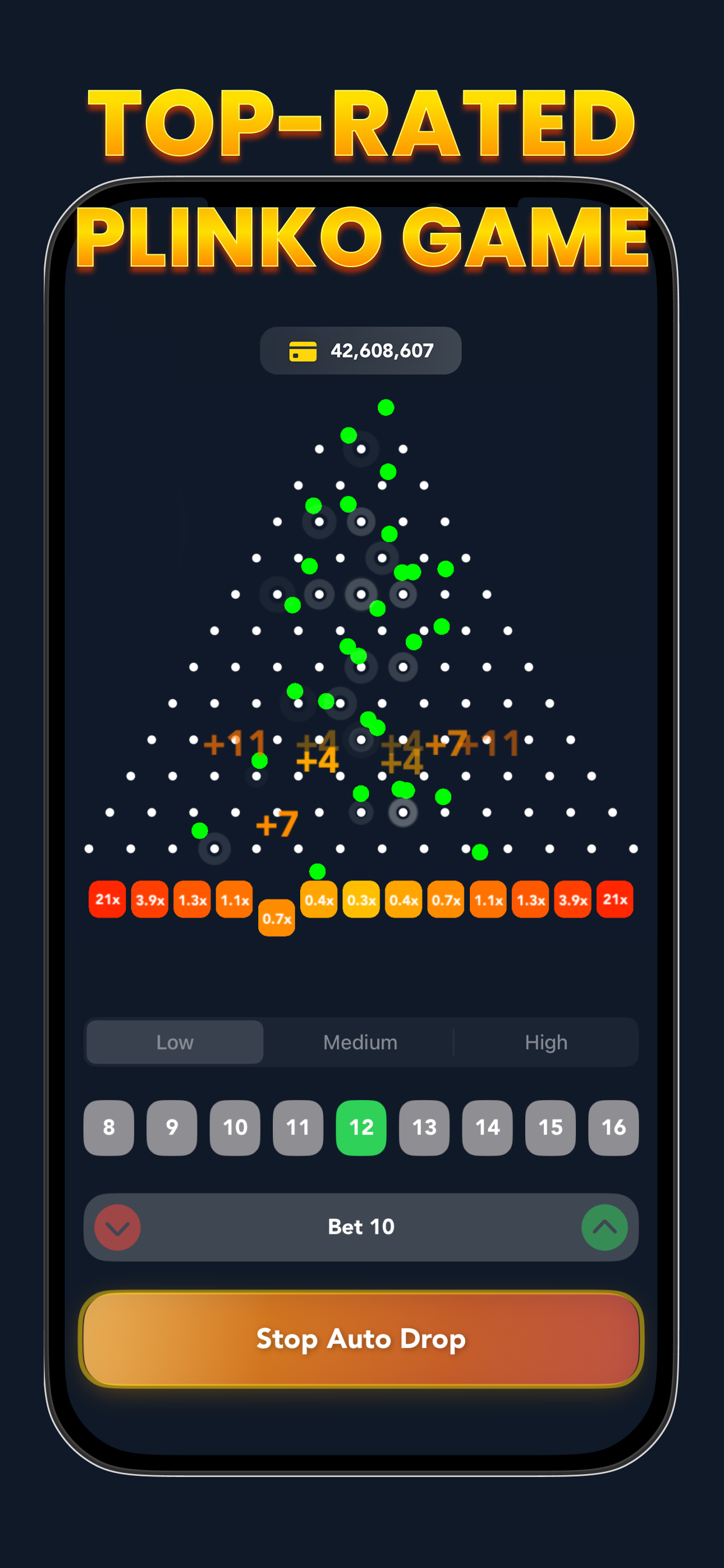
Of course, while the rules are simple, there's more going on under the surface than you might expect. Let me break down each piece.
Step-by-Step Tutorial: Your First Plinko Game
Alright, here's your practical Plinko tutorial. Whether you're about to play free Plinko in your browser or you've downloaded a mobile app, these steps apply to virtually every version of the game.
Step 1: Choose Your Settings
Most modern Plinko games let you adjust a few things before you start. The two big ones are number of rows and risk level. If this is your first time, go with the defaults or pick something in the middle — 12 rows and low or medium risk. You can always change these later once you understand how they affect gameplay.
Step 2: Set Your Bet or Ball Count
In free Plinko games, you'll usually have a virtual balance or unlimited drops. In versions with stakes, you'll set a bet amount per drop. If you're new, start small. There's no advantage to going big on your first few drops — you're still learning how the board behaves.
Step 3: Pick Your Drop Position
This is your one real decision. You can drop the ball from the far left, far right, dead center, or anywhere in between. I'll get into the strategy of this later, but for your first game? Go center. It's the most forgiving position and gives you a good feel for how the ball moves through the pegs.
Step 4: Drop the Ball
Click, tap, or release. The ball starts its journey down through the peg field. This is the part where you hold your breath. In digital versions, the physics engine calculates every collision in real time, so each drop genuinely produces a unique path.
Step 5: Watch and Learn
Pay attention to how the ball moves. Notice how it tends toward the center on low-risk boards. Notice how sometimes it takes a wild detour. Notice the sounds. After a few drops, you'll start to develop an intuitive feel for the game's behavior, even though you can't control it.
Step 6: Adjust and Drop Again
That's the beauty of Plinko — there's always another drop. Try a different starting position. Switch the risk level. Change the number of rows. Every adjustment makes the game feel slightly different.
Understanding the Board Layout
If you really want to understand how to play Plinko well, you need to understand the board. It's not just a random arrangement of pegs — the layout is carefully designed to create specific probability patterns.
The Peg Grid
A standard Plinko board has pegs arranged in a staggered grid. Each row is offset from the one above it, so when the ball falls between two pegs in one row, it hits a peg in the next row. This staggered pattern is what forces the ball to bounce left or right at every level — it can't just fall straight through.
The number of rows matters a lot. An 8-row board produces relatively predictable outcomes — the ball doesn't have many chances to deviate from its initial trajectory. A 16-row board is chaos — the ball has so many bounces that the starting position barely matters anymore. Most games default to 12 or 14 rows, which hits a sweet spot between predictability and surprise.
The Prize Slots
At the bottom of the board, you'll find a row of slots, each labeled with a value. Here's the pattern you'll see in almost every Plinko game:
- Center slots have moderate, safe values. These are where balls land most often.
- Near-center slots have slightly higher values. Still fairly common landing zones.
- Edge slots have the highest values (on high risk) or sometimes the lowest values. Balls rarely reach the edges, which is why the payouts are bigger there.
This slot arrangement mirrors the bell curve of probability. Since balls naturally cluster toward the center, the game puts the exciting prizes at the edges where they're harder to reach. It's elegant game design, really.
Risk Levels Explained
This is where Plinko gets interesting for people who want a bit more depth. Most digital versions of the game offer multiple risk levels, and understanding them completely changes how you approach the game.
Low Risk
On low risk, the slot values are relatively flat. The center slots might be worth 1x and the edge slots might be worth 3x or 5x. You won't see massive swings in either direction. Your results will be consistent — small gains, small losses, nothing too dramatic. This is perfect if you're playing to relax, if you're a Plinko beginner, or if you just want to watch balls bounce without any anxiety.
Medium Risk
Medium risk spreads the values wider. Center slots might drop to 0.5x while edge slots climb to 10x or higher. You'll experience more volatility — some drops will feel disappointing, but the occasional ball that makes it to an edge slot feels genuinely exciting. This is where most players settle once they're comfortable with the game.
High Risk
High risk is where Plinko turns into a rollercoaster. The center slots might be worth 0x or 0.2x — essentially nothing. But the edge slots? They can be worth 100x, 500x, or even 1,000x depending on the game. Most of your drops will land in those low-value center slots. But every once in a while, a ball will take a wild path to the edge, and the payoff is enormous.
High risk is thrilling but exhausting. I tend to play a few high-risk rounds when I want excitement, then switch back to medium when I want to actually breathe normally.
Tips for Beginners
Here are the Plinko tips I wish I'd known when I started. None of these will guarantee wins — nothing can, because Plinko is fundamentally a game of chance — but they'll help you enjoy the game more and avoid the mistakes that frustrate new players.
1. Start with Low Risk
I know high risk sounds more exciting. It is more exciting. But starting with high risk as a beginner is like learning to drive in a race car. You need to understand how the game feels before you crank up the volatility. Low risk lets you see the patterns, understand the bell curve, and develop realistic expectations. Then you can graduate to medium and high risk with your eyes open.
2. Drop from the Center First
Center drops are the most predictable. The ball has equal room to bounce left or right, and it'll usually end up somewhere near the middle. This gives you a baseline understanding of how the board behaves. Once you have that baseline, try edge drops and see how the outcomes change.
3. Pay Attention to Row Count
If your game lets you choose the number of rows, experiment with it. Fewer rows means your drop position matters more. More rows means more randomness. There's no right answer — it depends on whether you want some influence over the outcome or pure unpredictability.
4. Set a Session Budget
If you're playing a version with virtual currency or stakes, decide before you start how many drops you want to make. It's easy to get caught up in the "one more drop" loop. Having a number in mind helps you enjoy each drop rather than chasing a specific outcome.
5. Enjoy the Physics
Seriously. The best part of Plinko is watching the ball bounce. Don't just tap and check the result — watch the actual path. Notice how two balls dropped from the same position take completely different routes. Appreciate the chaos. That's what makes this game special.
For more advanced approaches, check out our Plinko strategy guide once you've got the basics down.
Ready to put these tips into practice?
Play Plinko for free right in your browser, or grab Pachinko Rush on iOS for the best mobile Plinko experience with realistic physics and adjustable risk levels.
Common Mistakes to Avoid
I've watched a lot of people play Plinko for the first time, and the same mistakes come up again and again. Here's what to watch out for.
Chasing Losses
You hit three low-value slots in a row, so you bump up the risk level or increase your bet thinking you're "due" for a big hit. You're not. Every single drop is independent. The board has no memory. The pegs don't know or care what happened on your last drop. This is the gambler's fallacy, and Plinko is particularly susceptible to it because the fast pace makes it easy to keep dropping without thinking.
Ignoring the Risk Settings
Some players never touch the risk level and wonder why the game feels monotonous. Others crank it to maximum and wonder why they keep getting terrible results. The risk setting is literally the biggest factor in your experience. Experiment with it. Match it to your mood. If you're stressed, go low. If you're feeling adventurous, go high. Don't just leave it on default forever.
Expecting Patterns
Human brains are pattern-recognition machines. You'll start to think you've noticed something — "balls dropped from the third slot always go right at row five" or "every fourth drop hits the edge." You haven't. You're seeing patterns in noise. This is called apophenia, and Plinko boards are specifically designed so that no such patterns exist. The sooner you accept the randomness, the more you'll enjoy the game.
Skipping the Free Versions
Plinko also appears in online casino platforms and other staked environments. If you're tempted to jump straight into those, pump the brakes. Play the free version first. Get comfortable with how the board works, how risk levels feel, and what the actual odds look like. Free Plinko gives you all the entertainment with none of the downside. There's no rush.
Playing Plinko Online vs. Physical Boards
Since you're learning how to play Plinko, it's worth understanding the differences between digital and physical versions, because they're not identical experiences.
Physical Plinko Boards
Physical boards — the kind you see at carnivals, arcades, or on The Price Is Right — use actual gravity and real collisions. The ball is a physical object with weight and texture. The pegs are real metal or wood. Environmental factors like humidity, surface wear, and even the temperature of the metal can subtly affect the ball's path.
The upside of physical boards is the tactile experience. Feeling the ball in your hand, hearing the real plink sounds, watching it bounce in real space — there's nothing quite like it. The downside is that physical boards can develop biases over time. A slightly bent peg or a worn surface can make certain paths more likely than others.
Online and Mobile Plinko
Digital Plinko — whether you play Plinko online in a browser or through a mobile app — uses physics engines to simulate every bounce. The best engines (the ones used in games like Pachinko Rush) calculate each collision individually, producing genuinely unique paths every time.
The advantages of digital Plinko are significant. You can adjust the number of rows, switch risk levels instantly, drop multiple balls at once, and play anywhere, anytime. There's no queue, no tokens, no waiting for your turn. You can play ten drops in the time it takes to play one on a physical board.
The disadvantage? You miss the tactile satisfaction of the real thing. But honestly, modern physics engines have gotten so good that the visual and audio experience of a well-made digital Plinko game comes remarkably close. And the convenience factor more than makes up for it.
Which Should You Start With?
If you're a total beginner asking how do you play Plinko for the first time, I'd recommend starting with a free online version. You can make dozens of drops in a few minutes, experiment with every setting, and develop a feel for the game without spending money or hunting for a physical board. Once you understand the mechanics, playing on a physical board at an arcade or fair becomes even more fun because you know exactly what's happening.
Advanced Concepts Worth Knowing
You don't need any of this to play Plinko. But if you're the kind of person who likes understanding the "why" behind things, here are some concepts that'll deepen your appreciation.
The Bell Curve Is Your Friend
On any Plinko board with enough rows, the landing distribution follows a bell curve (also called a normal distribution). This means roughly 68% of balls will land within one slot of the center, about 95% within two slots, and 99.7% within three slots. The remaining 0.3% are the wild outliers that reach the far edges. Understanding this helps you set realistic expectations for each drop.
Expected Value vs. Entertainment Value
If you calculate the expected value of a Plinko drop (the average return across thousands of drops), it's usually slightly negative in staked games and neutral in free games. But Plinko isn't about expected value — it's about the experience. The anticipation during the drop, the near-miss that almost hit the jackpot, the unexpected bounce that defied the odds — that's where the real value lives.
Volatility Is a Feature, Not a Bug
New players sometimes complain about inconsistent results, especially on high risk. But the volatility IS the game. Consistent results would make Plinko boring in about thirty seconds. The fact that any individual drop can surprise you is precisely what keeps you coming back. Embrace the variance. That's the whole point.
Getting Started Today
You now know everything you need to know about how to play Plinko. The rules are simple: drop a ball, watch it bounce, see where it lands. The strategy is minimal: choose your drop position, set your risk level, and let physics take over. The learning curve is essentially zero.
What Plinko offers isn't complexity. It offers that rare combination of simplicity and unpredictability that keeps your brain engaged without demanding anything from it. It's a game you can play for two minutes while waiting for coffee or for two hours when you can't sleep. It works either way.
If you're ready to try it, you can play Plinko for free right here — no download, no signup, just instant ball-dropping in your browser. Or if you want the premium mobile experience with space-themed visuals and buttery-smooth physics, grab Pachinko Rush on iOS.
Your first drop is always the hardest — not because it's difficult, but because you don't know what to expect. After that? You'll be hooked. Welcome to the world of Plinko.
Frequently Asked Questions About Playing Plinko
To play Plinko: (1) Choose a drop position along the top of the pegboard. (2) Release the ball. (3) Watch it bounce off rows of pegs, going left or right at each one. (4) The ball lands in a prize slot at the bottom — that slot determines your score or payout. You pick where to drop and physics does the rest. No buttons, no timing, no special skills required.
The core Plinko rules are simple: drop a ball from the top of a pegged board, let it bounce through rows of pegs, and collect the value of whichever slot it lands in at the bottom. Most versions let you choose your drop position and risk level. Higher risk means bigger potential prizes in the edge slots but smaller values in the center. Lower risk offers more consistent, moderate payouts.
Absolutely. Plinko is primarily a game of chance, so beginners have the same odds as experienced players on any individual drop. There's no complex skill to master. Beginners can improve their experience by starting with low-risk settings, dropping from the center for more consistent results, and gradually experimenting with higher risk levels as they get comfortable.
Plinko boards typically have between 8 and 16 rows of pegs. The original Price Is Right board had about 12 rows. In digital versions, you can often choose the number of rows — fewer rows (8–10) give more predictable outcomes, while more rows (14–16) create greater randomness. Most online Plinko games default to 12 or 14 rows.
The center is statistically the safest because the bell curve means the ball is most likely to land in center slots, where moderate values sit. However, if you're playing on high risk, the biggest prizes are at the far edges — and dropping from an edge gives a slightly better chance of reaching those slots. After enough rows of pegs, though, the starting position matters less than you'd think.
Plinko is overwhelmingly a game of luck. While you choose the initial drop position, the ball's path becomes essentially random after just 3–4 rows of pegs. The physics are chaotic — tiny variations in each bounce create wildly different outcomes. Your strategic choices are limited to drop position and risk level, but the final result is determined by chance.
You can play Plinko for free at freeplinko.com directly in your browser — no download or signup required. For mobile, Pachinko Rush is a free Plinko game for iPhone and iPad with realistic physics, adjustable risk levels, and multiple game modes.
Ready to Play?
Drop a ball through 16 rows of pegs, chase 1000× multipliers, and experience real physics — no download, no signup.
Play Plinko Online Free →