What Is a Plinko Ball Drop Game?
Let me paint you a picture. You're holding a ball at the top of a tall board covered in rows of evenly spaced pegs. You let go. The ball falls, hits the first peg, and bounces — maybe left, maybe right. Then it hits another peg. And another. Each collision sends it on a slightly different trajectory until, after a dozen or more rows of pegs, it drops into one of the slots at the bottom. Each slot has a different value. You hold your breath the entire way down.
That's a Plinko ball drop game in its purest form. The concept has been around since the 1870s (more on that in a second), but most people know it from The Price Is Right, where it became the single most beloved segment in the show's history. If you want the full backstory, I wrote a deep dive on what Plinko is and where it came from.
What makes the ball drop format so endlessly appealing is the tension between control and chaos. You choose where to drop the ball — that's your one moment of agency. After that, physics takes over completely. You're just a spectator to gravity, momentum, and a whole lot of collisions. And somehow, being helpless is the best part.
Today, Plinko ball games exist everywhere: physical arcade machines, browser-based simulators, and mobile apps. The format is always the same — ball, pegs, slots, unpredictability. But the quality of the experience varies wildly depending on how the physics are handled. We'll get into that.
The Physics Behind Every Ball Drop
I'll be honest: I wasn't a physics person in school. I was the kid who doodled in the margins during lectures about vectors. But something about Plinko physics grabbed me in a way that textbooks never did, because you can see the physics happening in real time. Every concept has a visible, tangible consequence.
Gravity: The Engine of the Whole Thing
Every Plinko ball drop starts with gravity. The ball accelerates downward at roughly 9.8 meters per second squared (on Earth, anyway — Plinko on Mars would be a very different vibe). Gravity is what converts your gentle release into the energy that powers every subsequent bounce. Without it, you'd just have a ball sitting on top of a peg doing nothing. Not much of a game.
But here's the thing most people miss: gravity doesn't just pull the ball straight down between pegs. It also affects how the ball interacts with each peg, because the speed at impact determines how energetically the ball rebounds. A ball that's been falling for six rows hits harder than one that's only fallen through two. The bounces get more dramatic as the ball descends, which is one reason the bottom half of a Plinko board is always more chaotic than the top.
Momentum and Collision: Where Things Get Wild
Every time the ball strikes a peg, two things happen simultaneously. First, the ball's downward momentum gets partially converted into horizontal momentum — it gets knocked sideways. Second, some energy is lost to the collision itself (absorbed by the peg, converted to sound, turned into heat). How much momentum transfers horizontally versus how much dissipates depends on the exact angle and speed of impact.
And this is where it gets really interesting: these calculations compound. A tiny difference in the first collision — hitting the peg just a hair to the left versus a hair to the right — changes the angle going into the second peg, which changes the third, which changes the fourth. By the time you're eight rows down, that microscopic initial difference has potentially sent the ball to a completely different side of the board.
Physicists call this sensitive dependence on initial conditions. Regular humans call it the butterfly effect. Plinko players call it "HOW DID IT END UP OVER THERE."
Friction and Spin: The Hidden Variables
There are two forces at play in a Plinko ball drop that most people never think about: friction and spin. When the ball grazes a peg rather than hitting it dead-on, friction between the surfaces imparts spin to the ball. A spinning ball doesn't bounce the same way a non-spinning ball does — its rotation creates a slight curving effect (the same principle that makes a curveball curve in baseball).
Over a dozen rows of pegs, accumulated spin can meaningfully pull a ball toward one side or the other. This is why even in a perfectly symmetrical Plinko board, balls don't always follow the neat statistical bell curve you'd expect. The spin adds a layer of real-world messiness that makes the game feel alive rather than mechanical.
The Forces Behind Every Plinko Ball Drop
- Gravity: Pulls the ball downward, accelerating it between peg rows
- Elastic collision: Converts downward momentum into horizontal deflection at each peg
- Friction: Creates spin when the ball grazes a peg at an angle
- Angular momentum: Accumulated spin alters subsequent bounce directions
- Energy dissipation: Each collision absorbs some kinetic energy as sound and heat
- Air resistance: Negligible per bounce, but compounded over 12–16 rows, it matters
The beautiful part? You don't need to understand any of this to enjoy a Plinko ball game. But once you do understand it, watching each drop becomes richer. You start noticing the spin. You start anticipating how a fast collision will play out differently from a slow one. The game doesn't change, but your appreciation of it deepens.
Free Plinko Ball Simulators Compared
Not all Plinko ball simulators are created equal. I've tried more of them than is probably healthy, and the differences come down to one critical question: is the simulator actually computing physics, or is it faking it?
Real Physics vs. Scripted Outcomes
A genuine Plinko balls simulator calculates every collision in real time — gravity, angles, friction, restitution (bounciness), the works. Each drop is a unique physics computation. Drop the ball from the exact same spot a hundred times and you'll get a hundred different paths.
A fake simulator, on the other hand, picks the landing slot first (using a random number generator or a weighted probability table) and then animates a ball path that looks realistic. It's basically a cartoon pretending to be physics. You can usually spot these because the bounces feel slightly "off" — the ball seems to change direction in ways that don't quite match what you'd expect from a real collision.
What to Look For in a Ball Drop Simulator
Here's my checklist after testing dozens of these things:
- Drop position control. Can you choose exactly where to release the ball? If the simulator forces a fixed drop point, it's limiting the experience.
- Variable paths. Drop five balls from the same spot. If they all take identical or suspiciously similar paths, the physics are fake.
- Adjustable rows. More rows means more collisions, which means more chaos. Good simulators let you change the row count.
- Risk levels. The ability to switch between low-risk (frequent small wins) and high-risk (rare big wins) configurations adds serious replay value.
- Smooth animation. Jerky or stuttering ball movement usually means the simulator is cutting corners on the calculations.
- No forced signups. If you have to create an account before you can watch a ball bounce off pegs, something has gone wrong with the internet.
The free Plinko game on this site checks all those boxes, by the way. No download, no account, just instant ball-dropping in your browser. I'm biased, obviously, but I genuinely think it's one of the best Plinko ball online experiences available.
Plinko Ball Demo — Try Before You Commit
One thing I love about the Plinko ball drop format is that it basically demos itself. You don't need a tutorial. You don't need instructions. You see the board, you see the ball, you drop it. The first bounce tells you everything you need to know about whether the physics feel right.
That's why a good Plinko ball demo is so important for any app or simulator. If the very first drop feels satisfying — if the ball has weight, if the bounces look natural, if you immediately want to drop another one — the game has you. If the first drop feels floaty or fake, you're closing the tab in five seconds.
I think about this a lot when people ask me how to play Plinko. The honest answer is: you already know how. You've known since you were a toddler rolling a ball off a table. The appeal of a ball drop game isn't in learning some system — it's in the pure sensory experience of watching physics unfold.
This is also why Plinko ball demos work so well for introducing people to a game or app. No video trailer, no feature list, no animated screenshots can compete with the simple act of letting someone drop one ball and watch what happens. If you're curious about what a high-quality ball drop experience feels like, the best thing I can tell you is: just try it. One drop. That's all it takes.
Playing Plinko Balls Online for Free
Here's the good news: you have never had more options for playing Plinko balls free online. The less good news: a lot of those options are mediocre. Let me save you some time.
Browser-Based Free Play
The fastest way to play a Plinko ball free game is directly in your web browser. No download, no app store, no waiting. You open a page, you drop balls. The best browser-based versions use WebGL or HTML5 Canvas to run physics simulations that rival dedicated apps.
The advantages are obvious: instant access from any device with a browser, no storage space used, no updates to install. The trade-off is that browser games typically can't push quite as many simultaneous balls or as many visual effects as a native app. But for straight-up ball-dropping satisfaction, browser play is hard to beat for convenience.
Mobile App Free Play
If you want the fullest Plinko ball experience on your phone — multiple board configurations, hundreds of simultaneous balls, immersive sound design — a dedicated app is the way to go. Native apps can tap into your phone's GPU for smoother physics and richer graphics than a browser can manage.
The important thing is finding an app that's actually free to enjoy, not just free to download. A Plinko ball game that locks basic features behind a paywall or interrupts every third drop with a video ad isn't really free — it's just paying in a different currency (your time and sanity).
A Note on Real-Money Plinko
Some platforms offer real-money Plinko ball games where you wager actual currency on the outcome. These exist in the online gaming space and they can be entertaining, but they're a fundamentally different experience from free-play Plinko. When money is on the line, the relaxing, meditative quality of watching balls bounce tends to get replaced by anxiety. The physics are the same, but the feeling is completely different.
This article is focused on the free-play side — Plinko as a physics toy, a stress reliever, and a genuinely fun way to kill fifteen minutes. If that's what you're after, you've got plenty of excellent free options.
The Pachinko Rush Physics Engine
Full disclosure: this section is about our app. But I think it's worth explaining because the physics engine is genuinely the thing that makes Pachinko Rush different from most Plinko ball games, and understanding how it works gives you a better appreciation for what separates a great ball drop game from a mediocre one.
Real-Time Collision Calculation
Every ball in Pachinko Rush is a physics object with mass, velocity, angular velocity, and a coefficient of restitution (bounciness). Every peg is a physics object with a position, radius, and friction coefficient. When a ball hits a peg, the engine calculates the exact collision — the contact point, the angle of incidence, the force transfer, the resulting spin — all in real time.
This isn't a lookup table. It isn't a random number deciding left or right. It's genuine Newtonian mechanics running at 60 frames per second on your phone. The same engine approach used in serious physics simulations, applied to the deeply unserious task of bouncing balls off pegs.
Why It Matters
You might be thinking: who cares if the physics are "real" as long as the game looks fun? Fair question. Here's my answer: you can feel the difference. Your brain is incredibly good at detecting unnatural motion. We evolved to track projectiles (for survival reasons that I'm glad no longer apply), and that ancient tracking system immediately flags physics that don't behave like real-world objects.
When the physics are right, your brain relaxes. The ball looks like a real ball doing real ball things. When the physics are faked, there's a subtle sense of wrongness — the uncanny valley, but for bouncing. Good physics create trust. Trust creates immersion. Immersion creates the flow state that makes you look up from your phone and realize forty-five minutes have vanished.
Ready to feel the difference real physics make?
Pachinko Rush has a full Newtonian physics engine, adjustable risk levels, and a space theme that makes every ball drop feel cinematic. Free on iPhone and iPad.
Play Free in Browser
Multi-Ball Drops and Why They're So Satisfying
Okay, I've saved the best part for last. Because if a single Plinko ball drop is satisfying, a multi-ball drop is transcendent.
The Visual Spectacle
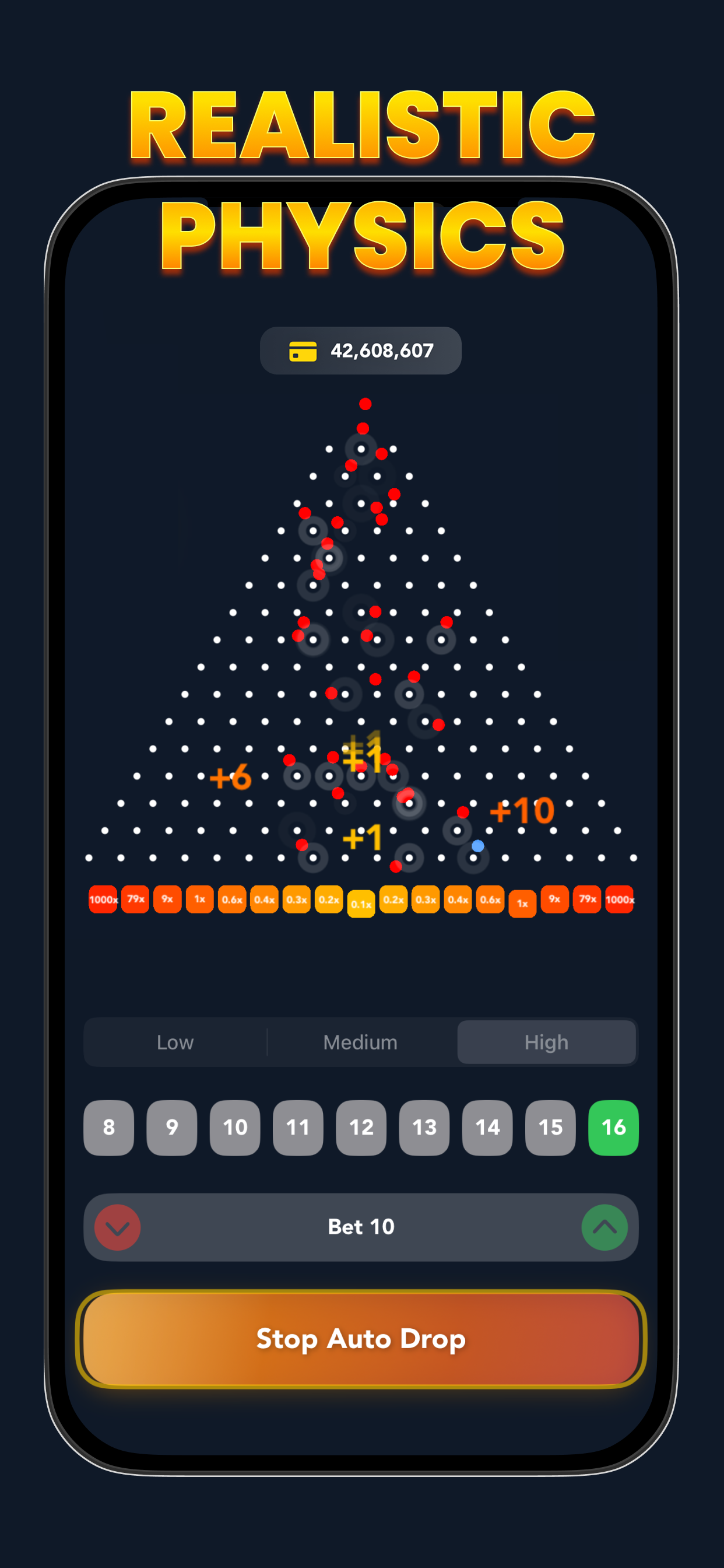
Imagine dropping not one ball but fifty. Simultaneously. They cascade down through the pegs in a shimmering avalanche, splitting and diverging and occasionally colliding with each other. Some cluster together for a few rows before a single peg scatters them in opposite directions. Others take wildly divergent paths from the very first bounce. The visual effect is somewhere between a fireworks display and a waterfall.
Multi-ball drops are where the bell curve becomes visible in real time. Drop a hundred balls from the center and watch them pile up at the bottom — most landing near the middle, fewer at the edges, creating that perfect normal distribution shape. You're literally watching a statistics textbook come to life, and it's gorgeous.
Ball-to-Ball Collisions
Here's where it gets interesting from a physics standpoint: in a multi-ball Plinko drop, the balls don't just interact with the pegs. They interact with each other. A ball that would have bounced left off a peg might instead collide with another ball and get deflected right. This adds an entirely new layer of chaos to the system.
In a single-ball drop, the board has a fixed number of pegs and the only variables are the ball's starting position and the collision physics. In a multi-ball drop, every other ball is essentially a moving obstacle, creating a dynamically changing maze. The number of possible outcomes scales exponentially with each additional ball. Ten balls? Astronomical. Fifty? Essentially infinite.
The ASMR Factor
There's a reason Plinko ball drop videos pull millions of views on social media. The sound of dozens of balls cascading through pegs — that rapid-fire plink-plink-plink-plink — hits some kind of deeply wired satisfaction center in the human brain. It's rhythmic without being repetitive. Predictable enough to be soothing, chaotic enough to be engaging. People use these videos to fall asleep. People use them to decompress after work. It's the most relaxing form of chaos I've ever encountered.
Good Plinko ball simulators let you adjust the number of balls per drop, which lets you dial in exactly the level of visual and auditory stimulation you want. One ball for contemplative observation. Ten for casual entertainment. A hundred for full sensory overload. The game scales to your mood, which is part of why the format has such incredible staying power.
Why We Can't Look Away
There's a concept in psychology called perceptual binding — your brain's tendency to track and group moving objects. When you watch a multi-ball Plinko drop, your visual system tries to follow individual balls through the chaos. It can't, obviously. There are too many. But it tries, and that effort creates a state of focused, relaxed attention that psychologists associate with flow states and meditation.
This is why people watch Plinko ball drops for ten, twenty, thirty minutes without getting bored. It's not mindless — it's the opposite. It's your brain doing extremely active visual processing in a context that feels effortless. It's a workout disguised as rest.
If you've never experienced a multi-ball Plinko drop, I genuinely envy you the first time. Start with something like the free Plinko game here and work your way up from five balls to fifty. You'll see what I mean.
Frequently Asked Questions About Plinko Ball Drop Games
A Plinko ball drop game is any game where you release a ball from the top of a vertical pegboard and watch it bounce off rows of pegs until it lands in a scoring slot at the bottom. The concept originated from the Galton board in the 1870s, was popularized on The Price Is Right in 1983, and now exists as arcade machines, browser games, and mobile apps like Pachinko Rush.
You can play Plinko ball games for free at freeplinko.com directly in your browser with no download or signup required. For mobile, Pachinko Rush is a free Plinko ball game for iPhone and iPad on the App Store with a real-time physics engine and adjustable settings.
Each time a Plinko ball strikes a peg, gravity, momentum, friction, and spin determine the deflection angle. The ball's downward momentum is partially converted to horizontal movement, while friction imparts spin that affects subsequent bounces. Over many rows of pegs, these micro-interactions compound into a chaotic system where the final landing position is practically unpredictable, though statistically the ball tends to land near the center in a bell-curve distribution.
A Plinko ball simulator is a digital program that recreates the ball drop experience using physics calculations. Good simulators compute gravity, collision angles, friction, spin, and energy dissipation in real time, producing unique paths for every drop. They typically let you adjust variables like drop position, number of peg rows, risk level, and number of simultaneous balls.
Yes. Pachinko Rush is a free Plinko ball drop game for iPhone and iPad, available on the App Store. You can also play in your mobile browser at freeplinko.com with no download required. Both options feature real physics simulation and work on any modern smartphone or tablet.
Pachinko Rush uses a real-time Newtonian physics engine that computes every collision individually. Each ball has mass, velocity, angular velocity, and restitution properties. Each peg has position, radius, and friction values. Unlike games that predetermine outcomes and animate paths, Pachinko Rush simulates genuine physics at 60 frames per second, producing authentically unpredictable results every time.
Ready to Play?
Drop a ball through 16 rows of pegs, chase 1000× multipliers, and experience real physics — no download, no signup.
Play Plinko Online Free →